


If you’ve ever wondered when human resources started, the short answer is the early 1900s. The first known personnel department was established at the National Cash Register Company (NCR) around 1901, following a series of strikes and worker walkouts that forced the company to rethink how it managed its workforce.
That tiny department is the seed that grew into modern HR. From safety officers in factories to payroll clerks to today’s people analytics leaders, the field has changed significantly over roughly 120 years. For small business owners, knowing this story helps you see why HR exists, what it owes its employees, and where it’s headed next.
The Industrial Revolution Made HR Necessary
Before the late 1800s, most work in the U.S. happened on family farms or in small shops. Owners and workers knew each other. Disputes got handled in person.
Factories changed that. Owners ran large operations. Workers became one of many. Conditions got dangerous, and grievances piled up. By the late 19th century, strikes, walkouts, and labor unrest had become a real business risk.
Some companies started looking for a better way. That’s the moment that opened the door for HR.
The Birth of HR in the Early 1900s
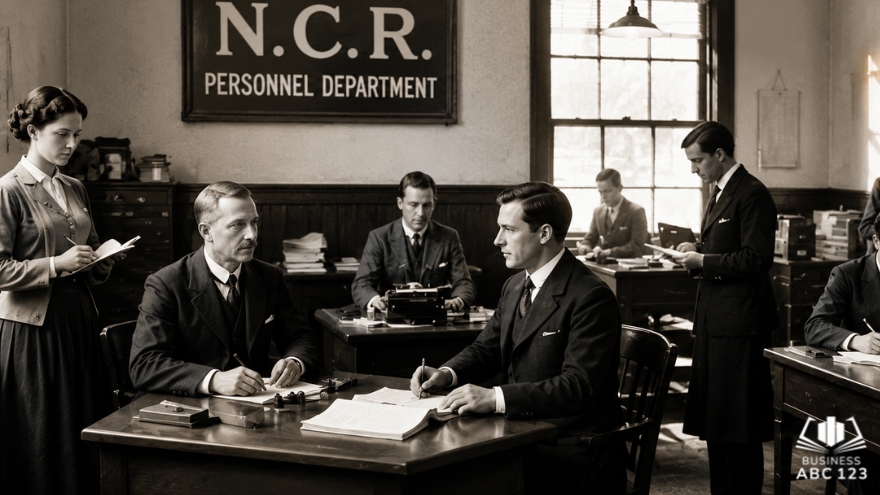
NCR’s personnel department, established under John H. Patterson, was set up to handle worker grievances, terminations, safety issues, and supervisor training. It was a direct response to costly labor disputes.
Around the same time, Frederick Taylor’s Shop Management and his theory of scientific management pushed companies to study work scientifically. Match workers to tasks. Train them. Measure them. Taylor is often called the “Father of Scientific Management,” and his work influenced early personnel practice.
Some historians point further back to Robert Owen, the 19th-century Welsh industrialist who advocated better working conditions and is sometimes called the “father of personnel management.”
By 1920, around 20% of American companies had a personnel department of some kind.
World Wars I and II Shaped Modern Hiring
Both world wars created massive labor demand. Suddenly, factories needed to hire fast and place workers in the right roles.
Personnel departments grew. They focused on recruitment, selection, IQ and aptitude testing, and training. The 1921 founding of the National Institute of Industrial Psychology in the UK gave the field a research backbone. After WWII, personnel work expanded to include morale, discipline, health and safety, and wage negotiation.
The function had grown beyond filing paperwork. It was starting to look strategic.
The Civil Rights Era and HR’s Compliance Years
The 1960s and 1970s changed HR forever.
Title VII of the Civil Rights Act of 1964 made employment discrimination based on race, color, religion, sex, and national origin illegal. It also created the U.S. Equal Employment Opportunity Commission, which opened in 1965 to enforce the law. The Age Discrimination in Employment Act, passed in 1967, protects workers 40 and older.
Personnel teams suddenly had to police hiring, firing, pay, and promotions for legal compliance. Penalties for getting it wrong were steep. HR became known, fairly or not, as the rule enforcer. It’s the era that built HR’s reputation for handbooks, mandatory training videos, and cautious memos.
It also made HR essential.
The 1980s and 1990s: From Personnel to Strategic HR
By the late 1980s, “human resources” replaced “personnel” as the standard term. The American Society for Personnel Administration rebranded as the Society for Human Resource Management (SHRM) in 1989.
Two key laws expanded HR’s job in the early 1990s:
- The Americans with Disabilities Act (1990), which required accommodations for qualified workers with disabilities.
- The Family and Medical Leave Act (1993), which gave eligible employees up to 12 weeks of job-protected leave for family or medical reasons.
The first generation of HR information systems (HRIS) also showed up around this time, replacing filing cabinets with software. HR began to gain a seat at the leadership table, and modern HR management strategies trace their roots directly to this era.
HR Today: Tech, Analytics, and Employee Experience

Modern HR looks nothing like that first NCR personnel office.
Cloud HRIS platforms (BambooHR, Gusto, Workday) handle employee records and payroll. People analytics dashboards track retention and engagement. AI tools screen resumes and suggest training. Remote and hybrid work have forced HR to redesign onboarding, communication, and culture from scratch.
A look at what HR teams do day to day shows just how much the role has stretched in the last 20 years. Today’s HR teams are part legal counsel, part coach, part data analyst, and part culture builder. If you want to keep up, choosing the right HR software for your business and browsing reliable human resources articles regularly are two of the easiest ways to stay current as the field keeps moving.
A Quick Timeline of HR History
- Late 1800s: The Industrial Revolution drives the need to manage factory workers.
- 1901: NCR sets up the first known personnel department.
- 1915: Human Resources Management Association of Chicago founded.
- 1916 to 1945: World wars expand recruiting, selection, and training functions.
- 1964: Civil Rights Act passes, creating EEOC and reshaping HR’s compliance role.
- 1967: The Age Discrimination in Employment Act passes.
- 1989: ASPA rebrands as SHRM.
- 1990: Americans with Disabilities Act becomes law.
- 1993: FMLA becomes law.
- 2000s: Cloud HRIS platforms reshape HR operations.
- 2020s: Remote work, people analytics, and AI redefine modern HR.
Final Thoughts
So, when did human resources start? In short, the early 1900s, with NCR’s personnel department as the first real example. From there it grew through two world wars, the civil rights era, the personnel-to-HR rename, and into today’s data-driven, tech-enabled function.
For small business owners, the takeaway is simple. HR isn’t a corporate luxury. It’s a 120-year-old discipline built to help businesses treat people well while running smartly. The earlier you start thinking like an HR pro, the stronger your business will be.
FAQs
Who is considered the father of human resources?
Robert Owen is often considered the father of personnel management, while Frederick Taylor helped shape modern HR practices through scientific management principles.
Why is it called human resources?
The term “human resources” became popular in the late 1970s and 1980s to emphasize employees as valuable business assets rather than just administrative personnel.
What was HR called before it was called human resources?
Before the term human resources, the field was commonly known as personnel management or personnel administration.
Which company created the first HR department?
The National Cash Register Company (NCR) is widely credited with creating one of the first personnel departments around 1901, following employee labor disputes.
When did human resources become a profession?
Human resources became more formalized as a profession during the 1920s and expanded significantly after World War II, with the adoption of modern labor laws and workplace policies.