


Running a business means dealing with people every single day. Whether you’re a solo founder, a small business owner, or a marketing manager who suddenly inherited the HR hat, you need a real grasp of what makes HR work.
Most articles you find talk about skills or qualifications, but rarely both. They also forget that small businesses often have one person doing it all. This guide breaks down the skills needed for human resource management, the credentials that support them, and the traits that separate good HR pros from great ones.
Why Strong HR Capabilities Matter More Than You Think
Hiring the wrong person costs money. Bad employee relations cost trust. Weak compliance can cost you the business.
According to the U.S. Bureau of Labor Statistics, there were about 221,900 human resources manager jobs in 2024, with a median annual wage of $140,030. That tells you something. Businesses pay well for people who can keep teams together, because the cost of not doing it is even higher.
For a small business, the stakes are sharper. You feel every hire, every exit, every misstep.
Skills, Qualifications, and Characteristics: What’s the Difference?
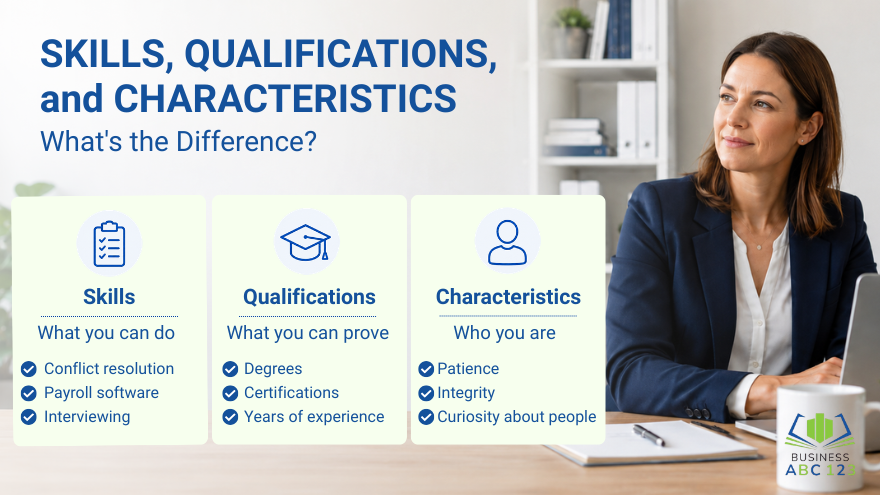
People mix these up all the time, but they matter for different reasons.
- Skills are what you can do. They’re learnable and measurable. Think conflict resolution, payroll software, or interviewing.
- Qualifications are what you can prove. Think degrees, certifications, and years of experience.
- Characteristics are who you are. Think patience, integrity, and curiosity about people.
You can hire someone with all the right qualifications and still end up with the wrong person. Skills get the job done. Characteristics decide how it gets done.
The People Skills Every HR Pro Should Have
These are the soft skills competitors call out, and for good reason. They matter most.
- Communication. Written, spoken, and listening. Most HR work happens in conversations. Strong communication in the workplace shapes everything from onboarding to exit interviews.
- Emotional intelligence. Reading the room, knowing when to push and when to pause.
- Conflict resolution. Two employees clash. A manager and a report disagree. Someone has to step in calmly.
- Negotiation. Salary talks, benefits and exit packages. HR negotiates daily.
- Discretion. HR sees private information all the time. People need to trust you to keep it private.
The BLS lists communication, decision-making, interpersonal, leadership, and organizational skills as the most important qualities for HR managers. That list still holds up.
Hard Skills and Technical Know-How
Soft skills get the headlines. Hard skills get the work done.
- HRIS platforms like BambooHR, Gusto, and Workday for managing employee data.
- Payroll and benefits administration, including tax withholding basics.
- Applicant tracking systems (ATS) for recruiting at scale.
- HR analytics. Reading reports on turnover, engagement, and time-to-hire.
- Employment law literacy. You don’t need a law degree, but you need to spot risk.
- Budget basics. Knowing what a hire actually costs the business.
If you’re a small business owner picking your first system, choosing the right HR software can save you years of headaches.
Qualifications in HR Management That Open Doors

This is where credentials come in. Most HR manager roles need real proof.
The BLS reports that human resources managers typically need a bachelor’s degree to enter the field, with some senior roles requiring a master’s. Common degree paths include human resources, business, communications, and psychology.
Certifications carry real weight. The Society for Human Resource Management offers the SHRM-CP and SHRM-SCP. The HR Certification Institute offers the aPHR for early-career pros and the PHR or SPHR for more experienced ones.
That said, qualifications in HR management are not the only path. Career changers, self-taught operators, and small business owners can build credibility through hands-on work, mentorship, and short courses. You don’t always need a four-year degree to do good HR work, especially at smaller companies.
Personality Traits and Human Resource Characteristics That Define Great HR Pros
This is the part most guides skip. The right human resource characteristics make every skill stronger.
- Integrity. People share hard truths with HR. You have to keep them safe.
- Patience. HR problems rarely resolve in one meeting.
- Curiosity about people. If you don’t enjoy people, this job will wear you down.
- Composure. Layoffs, complaints, and lawsuits test your nerves.
- Fair-mindedness. You serve both the company and its employees. The best HR pros find the middle without picking sides.
You can teach almost any skill. You can’t easily teach character.
Modern Skills Reshaping the HR Field
The field looks different from what it did ten years ago. HR pros today need:
- People analytics. Data is no longer optional.
- AI literacy. Tools now screen resumes, draft job posts, and predict turnover.
- Remote and hybrid workforce management. Different rules, different norms.
- DEI program design. Building fair hiring and pay practices.
- Employee experience design. Treating internal culture like a product.
These skills often distinguish a good HR generalist from a senior HR leader.
HR Skills Small Business Owners Actually Need
Most small business owners don’t hire an HR manager until they have 30 or more employees. Before that, you’re it.
You don’t need every skill on this list. You need enough to:
- Write clear job descriptions and run fair interviews.
- Set up basic payroll and benefits.
- Stay on the right side of employment law.
- Handle the first hard conversation when it comes.
- Know when to call in outside help.
A clear sense of what HR teams do day to day helps you decide what to handle yourself and what to outsource.
How to Build and Strengthen Your HR Skill Set
Skill building is a habit, not an event.
- Take one short course this quarter. Coursera, LinkedIn Learning, and SHRM all run good programs.
- Find a mentor. A local SHRM chapter is a good place to start.
- Read SHRM news and blogs weekly to stay on top of industry shifts.
- Volunteer for a stretch project at work that touches people, policy, or process.
- Track what you do well and where you struggle. Pick one gap to close each quarter.
The pros who keep growing are the ones who treat learning as part of the job.
Common Pitfalls to Avoid
A few mistakes show up often:
- Chasing certifications without building real-world reps.
- Hiding behind policy instead of having hard conversations.
- Ignoring tech and data.
- Trying to learn every skill at once instead of stacking them.
- Confusing being liked with being respected.
Final Thoughts
The skills needed for human resource management are wider than most people think. You need people skills, technical skills, the right qualifications, and the right traits. Small business owners need a smart subset of all four.
Start with one area. Build steady reps. Get one credential under your belt if you want a formal HR career. Keep showing up for your people. That’s the work, and that’s what makes HR worth doing.
FAQs
Do you need a degree to work in HR?
A bachelor’s degree is the most common path, but smaller companies often hire based on experience, certifications, or hands-on work. The SHRM-CP and aPHR are good options if you don’t have a four-year HR degree.
What is the most important HR skill?
Communication wins. Almost every other HR skill, from conflict resolution to negotiation, builds on the ability to listen well and speak clearly.
Can a small business owner be their own HR person?
Yes, especially under 25 to 30 employees, as long as you cover the basics like hiring, payroll, compliance, and clear policies. Outsource or hire help once the workload starts pulling you away from running the business.
What certifications carry the most weight in HR?
The SHRM-CP, SHRM-SCP, PHR, and SPHR are the most recognized in the U.S. The aPHR is a strong starter for anyone early in their HR career.
How long does it take to become an HR manager?
Most people spend four years on a bachelor’s and another five or more years in HR specialist roles before reaching manager level. The BLS lists five or more years of related work experience as typical.