


So you’re thinking about a career in business management, or maybe you’re already in one and wondering if your paycheck matches the market. Either way, the question is fair: how much does a business management professional make these days?
According to the U.S. Bureau of Labor Statistics, the median annual wage for management occupations was $122,090 as of May 2024, well above the $49,500 median for all U.S. workers. But that’s just the middle of the road. Some people in this field clear $200,000 a year. Others start closer to $55,000. The range is wide, and where you land depends on a handful of choices you can actually control.
Let’s break down the numbers, the factors that shape them, and the moves that bump your pay faster than most people realize.
What Counts as a Business Management Professional?
Before we talk about money, let’s get the title sorted. “Business management” is an umbrella term. The CareerOneStop career cluster from the U.S. Department of Labor groups it under business management and administration, covering executives, general and operations managers, financial managers, HR managers, and more.
In day-to-day terms, these folks handle people, budgets, processes, and performance. The exact title you hold matters because pay shifts noticeably with each step up. For example, the BLS lists chief executives at a median of $206,420 a year, while general and operations managers earn $102,950.
What’s the Average Business Management Salary in 2026?
Here’s how the data lines up:
- The U.S. Bureau of Labor Statistics puts the median annual wage for management occupations at $122,090 (May 2024).
- General and operations managers earn a median of $102,950, with the top 10% making more than $239,200.
- Top executives earn a median of $206,420.
- Entry-level business manager roles often start at $55,000 to $70,000, based on aggregate job posting data.
Why the wide range? Different sources pull from different job titles. Senior leadership skews the average up. Entry-level positions pull it down. Most people in business management earn between $80,000 and $130,000 a year.
Business Management Salary by Experience Level
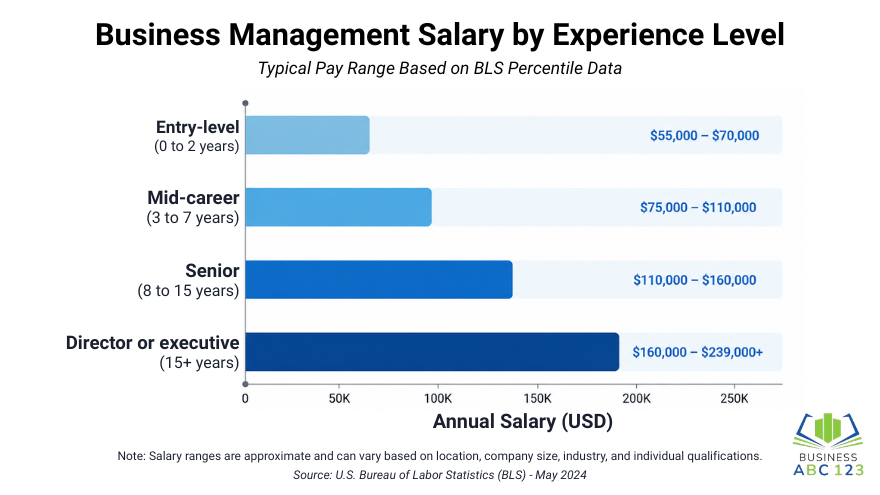
Here’s a closer look at business management salaries based on experience level, using typical pay ranges from BLS percentile data:
- Entry-level (0 to 2 years): $55,000 to $70,000
- Mid-career (3 to 7 years): $75,000 to $110,000
- Senior (8 to 15 years): $110,000 to $160,000
- Director or executive (15+ years): $160,000 to $239,000 and up
The biggest jumps happen between mid-career and senior roles, usually when you take on profit-and-loss responsibility for a team or product line.
Which Industries Pay Business Management Professionals the Most?
The industry you pick shapes your earning ceiling more than your degree ever will. Based on May 2024 BLS data:
- Finance and banking: Financial managers earn a median of $161,700, with the top 10% above $239,200
- Marketing: Marketing managers earn a median of $171,520
- Sales: Sales managers earn a median of $160,930
- Healthcare: Medical and health services managers earn a median of $117,960, and experts expect the field to grow by 23% through 2034.
- Manufacturing and engineering: Architectural and engineering managers earn a median of $175,710
- Retail and hospitality: Lower base salaries but easier to break into
Strong performance in these industries often comes down to applying business management best practices, since they help professionals improve efficiency, decision-making, and long-term results regardless of the sector.
How Location Changes Your Paycheck
Where you work matters almost as much as what you do. According to the BLS Occupational Employment and Wage Statistics, the top-paying states for general and operations managers include New York, New Jersey, Washington, D.C., Massachusetts, and California.
But here’s the catch. A business manager in Texas making $90,000 can sometimes have more left over at month’s end than one making $130,000 in Manhattan. Cost of living is the silent factor most people forget to run the math on.
Remote vs In-Office: Does It Affect Pay?
This question gets asked more every year. Fully remote business management roles tend to pay close to in-office in tech and finance. In traditional industries like manufacturing or retail, remote work often comes with a slight pay adjustment. Hybrid is now the most common setup, and it usually pays the same as full in-office.
The trade-off isn’t just money. It’s flexibility, commute time, and visibility when promotions come around.
The Pay Beyond Your Paycheck
The base salary is just one piece. Don’t skip the rest.
- Annual bonuses: Usually 5% to 25% of base, depending on your level and how the company performs
- Profit sharing: Common in private companies and consulting firms
- Stock options or RSUs: Public companies hand these out, and they can be life-changing in tech
- Benefits: A solid 401(k) match, healthcare, and PTO add real dollar value
- Consulting comp: The BLS notes that consulting roles frequently include base plus year-end bonuses
When comparing two job offers, look at total compensation, not just the number on the offer letter.
What Affects Your Salary the Most
A few factors move the needle harder than others:
- Experience. The biggest single driver. Years compound.
- Industry. Same job, different industry, totally different pay.
- Company size. Bigger companies generally pay more, often with stronger bonuses and equity packages.
- Education. A bachelor’s is the floor for most roles, according to the BLS Management Occupations handbook. An MBA helps in finance, consulting, and tech.
- Certifications. PMP, Lean Six Sigma, and similar credentials can boost pay.
- Specialized skills. The business management skills that pay the most are P&L ownership, data analysis, and financial modeling.
These factors all work together and play a big role in helping professionals succeed in business management, especially as responsibilities grow over time.
What Can Push Your Salary Higher?

A few moves consistently lift business management pay above the average:
- Switching companies every 3 to 5 years often pays more than staying put for a similar period.
- Owning profit and loss numbers moves you into a higher pay band because strong business operations directly drive the revenue, and companies pay extra to protect them.
- Adding a PMP or Six Sigma certification can raise base pay.
- Working in finance, tech, or pharma pays well above the retail or hospitality sector.
- Negotiating with proof (numbers you’ve hit and costs you’ve saved) yields better results than negotiating with confidence alone.
What Do Self-Employed and Fractional Business Managers Earn?
Independent consultants and fractional COOs typically charge $100 to $300 per hour, with experienced specialists commanding higher rates in niche fields. The BLS notes that self-employed management analysts are usually paid directly by clients, either hourly or on a project basis. A steady book of business can mean $150,000 to $400,000 in gross income, though net pay drops once you account for taxes, benefits, and unpaid time.
Final Thoughts
So, how much does a business management make? The honest answer is anywhere from $55,000 to $239,000 and beyond, depending on the title, the industry, the location, and the level of experience. The BLS median sits at $122,090, but very few people are actually average. Most fall somewhere across that wide spread, and the gap between the bottom and the top usually comes down to a few specific factors stacking together: industry, certifications, P&L responsibility, and the willingness to negotiate or switch companies when the timing’s right.
FAQs
How much does an entry-level business management professional make?
Most start between $55,000 and $70,000 a year, depending on the industry, city, and company size.
What’s the highest-paying business management role?
Senior roles like financial managers and chief executives top the list, with BLS data showing chief executives at a median of $206,420.
Do business managers actually get bonuses?
Most do, especially at mid-size and large companies, with bonuses usually running 5% to 25% of base salary.
How long does it take to hit a six-figure salary in business management?
For most people, it takes somewhere between 5 and 10 years, faster if you’re in a high-paying industry or willing to switch companies.
Which industry pays business management professionals the most?
Finance leads the pack, followed by engineering, marketing, and sales, all of which sit well above the $122,090 BLS median.