


If you are trying to understand Corporate vs Business Level Strategy, you are not alone. Many business owners, managers, and even new entrepreneurs often confuse these two levels of strategy. While they may sound similar, they serve very different purposes. Knowing the difference helps businesses make smarter decisions, improve growth, and stay competitive.
A clear strategy gives structure to business decisions, and having a solid grasp of business strategy makes it easier to see how corporate strategy focuses on the bigger picture, while business-level strategy focuses on competing within specific markets. When both work together, businesses can grow with more purpose and direction.
What Is Corporate Strategy?
Corporate strategy focuses on the overall direction of a company and shapes its long-term growth. It is usually created by top executives and business leaders who make major decisions that affect the entire organization. These decisions may include entering new markets, buying other companies, launching new business units, managing multiple brands, or allocating resources across departments. The goal is to guide the company’s future and create sustainable growth across all areas of the business.
For example, when a company decides to expand internationally or acquire another business, that is corporate strategy in action. It looks at the bigger picture and helps leaders decide where the company should go overall. In simple terms, corporate strategy focuses on the entire organization and its broader growth path.
What Is a Business Level Strategy?
Business-level strategy focuses on how a specific part of the business competes successfully in its market. Instead of managing the entire company, it centers on individual products, services, or business units. This includes decisions related to pricing, customer service, product quality, marketing, and building a competitive advantage that helps the business stand out.
For example, one division of a large company may compete by offering lower prices, while another may focus on premium quality or better customer experience. Business-level strategy is more focused on direct competition and customer needs. In simple terms, it answers how a business can succeed within its market while supporting larger company goals.
Corporate Strategy vs Business Level Strategy: Key Differences

| Corporate Strategy | Business Level Strategy |
|---|---|
| Focuses on the entire company | Focuses on specific markets or products |
| Guides overall business growth | Builds competitive advantage in the market |
| Involves long-term decisions | Involves medium-term planning |
| Managed by top leadership or executives | Managed by division or department leaders |
| Includes diversification, expansion, and acquisitions | Includes pricing, service, and market positioning |
| Sets the overall business direction | Determines how to compete successfully |
| Covers multiple business units or brands | Focuses on individual products or services |
| Answers where the company should grow | Answers how the business should win |
How Corporate and Business Strategies Work Together
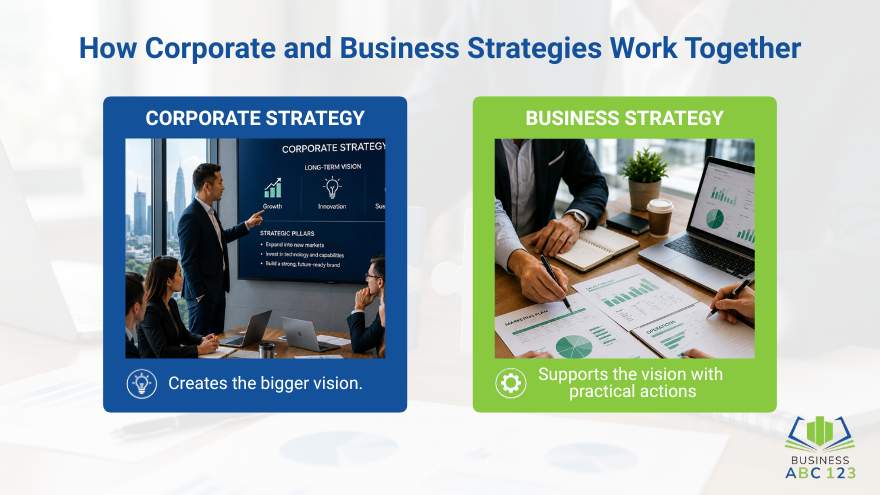
These strategies should not work separately. Corporate strategy creates the bigger vision, while business strategy supports it with practical actions, which is why building an effective business strategy is so important for long-term success.
For example:
- The corporate strategy may decide to enter the fitness industry
- Business strategy may focus on offering affordable fitness products
Both levels need alignment.
Without this connection, businesses may waste resources or create conflicting goals.
Strong companies use both strategies together so every part of the business supports long-term success.
When Businesses Need Corporate Strategy
Corporate strategy becomes more important when businesses grow larger.
This usually applies to:
- Multi-brand companies
- Large organizations
- Companies entering new industries
- Businesses considering acquisitions
- Enterprises managing multiple departments
If a business has several moving parts, corporate strategy helps keep everything aligned.
When Businesses Need Business-Level Strategy
Business-level strategy is essential for:
- Small businesses
- Startups
- Single-product companies
- Local businesses
- Niche brands
Even small companies need a clear competitive plan to compete effectively and make their business more profitable.
Without it, they may struggle to stand out in crowded markets.
Mistakes to Avoid When Developing a Strategy
Many businesses struggle with strategy because they often make it more complicated than it needs to be. Common mistakes include confusing corporate strategy with business-level strategy, setting unclear goals, ignoring customer needs, poor resource planning, skipping helpful tools like SWOT analysis, failing to track results, and not adjusting strategies as the market changes. In most cases, simple and clear planning works far better than overly complicated systems, helping businesses stay focused, practical, and easier to manage over time.
Final Thoughts
Knowing the difference between Corporate and Business-Level Strategy helps businesses create clearer goals, make better decisions, and achieve stronger long-term growth. Corporate strategy focuses on the larger direction of the business, while business level strategy focuses on winning within specific markets, and both work better when you evaluate strategy success along the way.
At the end of the day, Corporate vs Business Level Strategy is about balancing big-picture growth with practical competition so your business can stay focused, profitable, and prepared for future success.
FAQs
What is the main difference between corporate and business-level strategy?
Corporate strategy focuses on overall company growth, while business level strategy focuses on competing in specific markets.
Can small businesses use corporate strategy?
Small businesses may use a simple corporate strategy if they plan to expand, but a business-level strategy is often the main focus.
Why are both strategies important?
Corporate strategy provides direction, while business strategy helps businesses compete effectively.
Who creates corporate strategy?
Top executives and company leadership usually develop corporate strategy.
How often should business strategies be reviewed?
Most businesses should review strategies every few months to stay aligned with market changes.