

Running a business without checking if your strategy works is like driving without looking at the road. You might keep moving, but you don’t really know if you’re heading in the right direction. That’s why learning how to measure business strategy success is so important. It helps you understand what’s working, what’s not, and where to focus next.
The good news is, you don’t need complicated tools or deep technical knowledge to figure this out. You need clear goals, a few key numbers, and the habit of regularly reviewing your progress. In this guide, we’ll walk through simple ways to track and evaluate your business strategy to make better decisions.
What Does “Business Strategy Success” Really Mean?

You’ve got a plan and clear goals in place, but the real question is simple. Is it actually working?
Many business owners struggle with how to measure the success of their business strategy. It’s easy to look at revenue and assume everything is fine, but real success goes beyond just making money. A strong strategy shows up in steady progress. You start moving closer to your long-term goals, your team knows what needs to be done, customers keep coming back, and the business grows steadily. This is why having a strong foundation matters, and it starts with developing an effective business strategy.
It also helps to understand the difference between strategy and execution. Poor execution can still make a good strategy fail. At the same time, a weak strategy might bring short-term results but won’t last. If you’re unsure whether your direction is right, it also helps to evaluate your business strategy. In the end, success is not about quick wins. It’s about consistent progress that holds up over time.
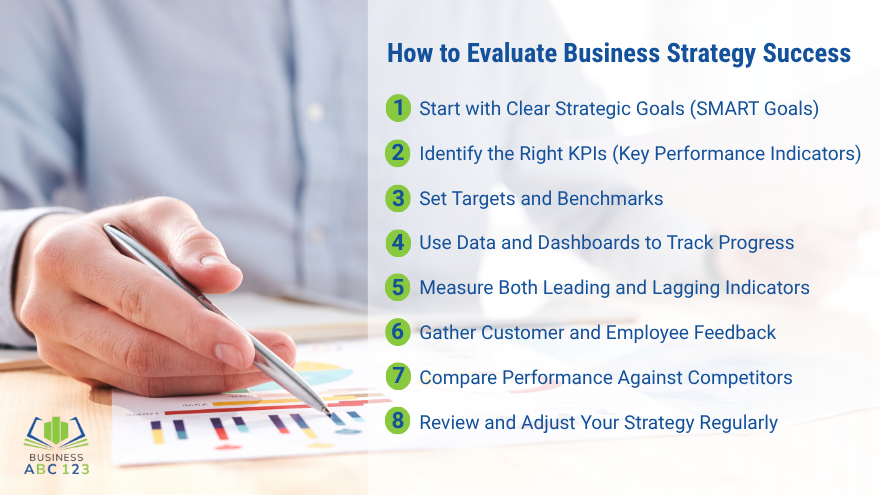
Step-by-Step: How to Evaluate Business Strategy Success
Let’s break this down into simple steps you can actually follow.
Step #1. Start with Clear Strategic Goals (SMART Goals)
You can’t measure anything if your goals are vague.
Instead of saying “increase sales,” say:
- Increase sales by 15% in 6 months
- Get 200 new customers this quarter
Having clear goals allows you to measure the effectiveness of your business strategy. Without specific targets, it’s hard to know what’s working and what needs adjustment. Clear goals give you something concrete to track and improve over time.
Step #2. Identify the Right KPIs (Key Performance Indicators)
KPIs are just numbers that show if you’re on track.
Pick a few that matter most. Don’t overdo it.
Examples:
- Revenue growth
- Customer retention rate
- Website conversions
- Cost per lead
The key is to align your KPIs with your goals if your goal is growth, track growth-related numbers.
Step #3. Set Targets and Benchmarks
Now that you have KPIs, define what success looks like.
Ask yourself:
- What number are we aiming for?
- How did we perform last year?
- What are competitors achieving?
For example:
- Increase customer retention from 60% to 75%
Targets give your data meaning. Without them, numbers are just numbers.
Step #4. Use Data and Dashboards to Track Progress
You don’t need fancy tools. Even a simple spreadsheet can work. What matters is consistency. Track your numbers weekly or monthly. Keep everything in one place so it’s easy to review.
Dashboards help you:
- Spot trends early
- See what’s working
- Catch problems before they grow
Good business tracking also connects with managing business effectively, especially when decisions rely on clear data.
Step #5. Measure Both Leading and Lagging Indicators
Many people often miss this step. You need two types of data:
Leading indicators
These show future results
- Website traffic
- Leads
- Email sign-ups
Lagging indicators
These show the final results
- Revenue
- Profit
- Sales
If you only track results, you react too late. Leading indicators help you act early.
Step #6. Gather Customer and Employee Feedback
Numbers don’t tell the full story.
Talk to your customers:
- Why did they choose you?
- What do they like or dislike?
Ask your team:
- What’s working?
- What’s slowing them down?
Feedback helps you see gaps that data alone might miss.
Step #7. Compare Performance Against Competitors
You don’t operate in a vacuum.
Look at:
- Pricing
- Market share
- Customer reviews
- Product offerings
This gives you context. If your growth is slow but the market is also slow, that’s different from falling behind. Understanding performance also connects with evaluating and scaling a business, especially when planning long-term growth.
Step #8. Review and Adjust Your Strategy Regularly
Don’t wait until the end of the year.
Set a schedule:
- Monthly check-ins
- Quarterly reviews
Ask:
- What’s working?
- What needs to change?
Adjust your plan based on real data. Flexibility keeps your strategy alive.
Example of Measuring Strategy Success
Let’s make this simple.
A small online store wants to increase sales.
Goal:
Increase online revenue by 20% in 6 months
KPIs:
- Website traffic
- Conversion rate
- Average order value
Actions:
- Improve product pages
- Run ads
- Offer discounts
Results after 6 months:
- Traffic increased by 30%
- Conversion rate improved from 2% to 3%
- Revenue increased by 22%
This shows the strategy worked. If revenue didn’t grow, they would review and adjust their approach based on the data and feedback. This process also ties closely with understanding how to improve business profitability, especially when focusing on long-term growth and stronger financial performance.
Final Thought
At the end of the day, learning how to measure business strategy success is about keeping things clear and consistent, especially when you are just starting out and still figuring out how to start a business properly. You don’t need complex systems to get real results. Focus on your goals, track the right numbers, and review them regularly. Listen to feedback, stay flexible, and make changes when needed. A strategy that adapts based on real performance is the one that helps your business grow over time.
FAQs
1. How do I know if my business strategy is actually working?
Check if you’re hitting your goals and if your key numbers are improving. If they are, your strategy is working. If not, it may need changes.
2. What are the most important metrics to track?
Focus on a few key numbers like revenue, customer retention, and conversions. Track what directly connects to your goals.
3. How often should I review my business strategy?
Review it monthly for quick checks, and do a deeper review every quarter to make improvements.
4. Can a strategy still be successful even if profits are slow at first?
Yes. Some strategies take time to show results, especially if they focus on growth or building customer trust.
5. What should I do if my strategy is not working?
Look at your data, find the problem, and adjust your approach. A strategy should always improve based on results.