


Most businesses today depend on technology to keep daily work running, but things don’t always go smoothly. Systems slow down, requests pile up, and small IT issues can easily disrupt operations if there’s no proper structure in place. That’s where information technology service management comes in.
Information technology service management is the process businesses use to organize and manage IT support more effectively. It helps teams manage issues, service requests, and system updates without confusion or delay.
In this article, you’ll learn what IT service management is, why it matters, how it works, its key processes, and the benefits and challenges it brings.
What Information Technology Service Management Is
Information technology service management is a way for companies to organize IT support and services. It focuses on how IT teams handle issues, respond to requests, and keep technology running smoothly.
In simple terms, it is the system that helps IT teams address daily tech problems within a business. This can include fixing system errors, helping employees with access issues, or maintaining business tools.
Most companies use Information Technology Service Management every day, even if they don’t notice it. It is also known as ITSM and plays a key role in IT support services and daily business operations.
Why Information Technology Service Management Is Important
Information technology service management helps businesses stay organized when dealing with IT problems. Without it, support requests can become confusing and slow.
Here’s why it matters:
- Keeps IT services organized and structured
- Helps solve problems faster
- Reduces system downtime
- Improves support for employees
- Makes IT work easier to manage
Without ITSM, small issues can pile up, affecting daily operations and slowing business improvement through IT.
Benefits of IT Service Management

ITSM gives businesses several clear benefits:
1. Faster problem solving
Issues are tracked and resolved more quickly.
2. Better support experience
Employees know where to report issues and get updates.
3. Fewer repeated problems
Teams can fix root causes, not just symptoms.
4. Higher productivity
Less downtime means smoother daily work.
5. More stable systems
IT operations become more reliable and organized.
Information Technology Service Management Processes You Should Know
IT service management is built around a few core processes:
Incident management
Fixes unexpected issues like system errors or downtime.
Service request handling
Manages day-to-day requests, like password resets and software access.
Problem management
Finds the root cause of repeated issues instead of just fixing symptoms.
Change management
Controls updates and system changes to avoid disruptions.
These processes help IT teams stay organized and respond in a structured way.
How Information Technology Service Management Works
ITSM works by tracking and managing all IT requests in one system.
Here’s a simple flow:
- A user reports an issue or sends a request
- The system creates a ticket
- The ticket is assigned to the right IT team
- The issue is fixed
- The ticket is closed once it is resolved
This system helps ensure that no request is missed and that everything is properly tracked. Using the right systems can also support technology’s role in business growth over time, especially as companies manage more day-to-day operations.
Tools Used in Information Technology Service Management
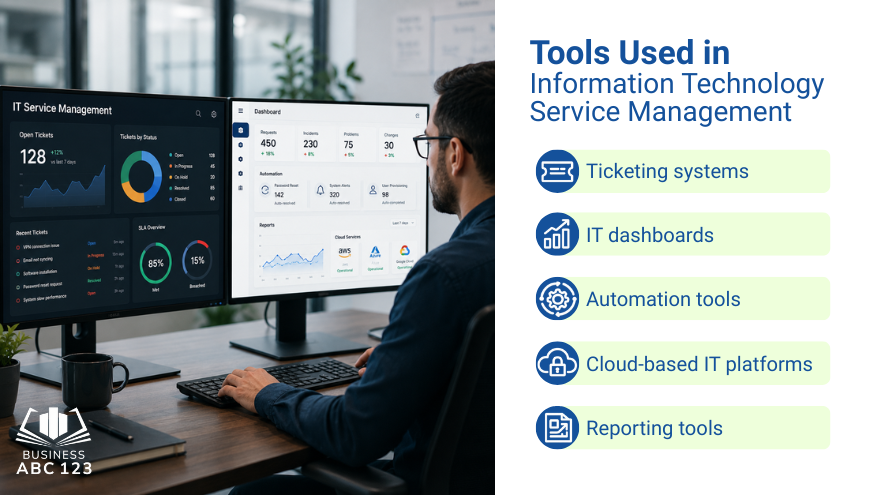
Most companies use software tools to manage IT service management more easily.
Common tools include:
- Ticketing systems
- IT dashboards
- Automation tools
- Cloud-based IT platforms
- Reporting tools
These tools help IT teams track issues, respond faster, and reduce manual work. Automation also helps with simple tasks like password resets and system alerts. Many businesses also work with a firm that offers tailored business solutions to improve how these systems are set up, managed, and supported.
Common Information Technology Service Management Problems
Even with ITSM in place, some challenges can happen:
- Slow response times: Too many requests can delay support.
- Poor communication: Users may not get updates on their issues.
- No clear process: Without structure, requests can get lost.
- Weak tracking systems: Problems are harder to improve if not recorded properly.
These issues usually come from a weak setup or poor system use3.
Final Thought
Information technology service management helps businesses manage IT support in a clear and organized way. It reduces confusion, improves response time, and keeps systems running more smoothly. When applied properly, information technology service management helps teams handle issues faster and maintain better control over daily IT operations.
FAQs
What is information technology service management?
Information technology service management is a system used by businesses to manage IT support, handle service requests, and fix technical issues in an organized way.
Why is IT service management important for businesses?
It helps reduce downtime, improves IT support speed, keeps systems organized, and makes daily technology operations easier to manage.
What are the main processes in IT service management?
The main processes include incident management, service request handling, problem management, and change management.
What does a consulting firm that offers information technology project management services do?
A consulting firm that offers information technology project management services helps businesses plan, organize, and manage IT projects to ensure systems are delivered and maintained properly.
How does IT service management improve daily business operations?
It improves operations by making IT support faster, reducing repeated issues, tracking requests properly, and keeping systems stable for everyday work.